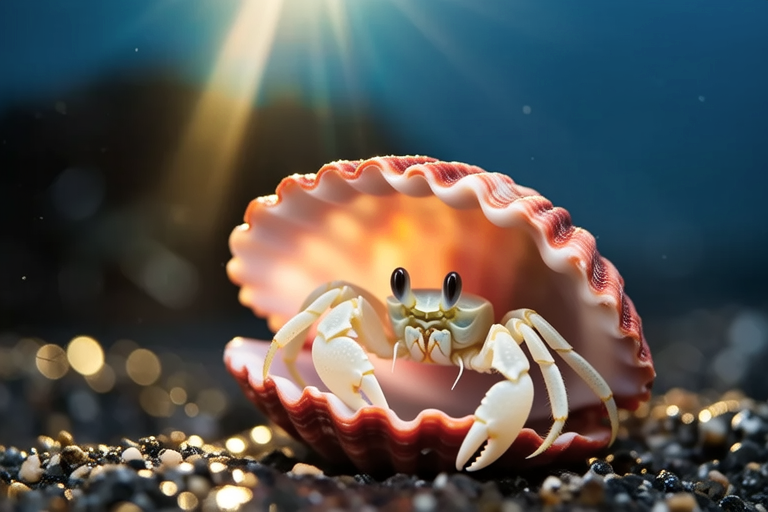
The Fascinating Life of Pea Crabs: Inside the Clam Shell
In the vast and mysterious underwater realm, one of the most remarkable partnerships unfolds within the confines of a clam’s shell. Pea crabs, tiny crustaceans named for their diminutive size, share an intimate and symbiotic relationship with their molluscan hosts. This article delves into the intricate world of pea crabs, exploring their unique adaptations, the benefits and challenges of their lifestyle, and the significance of studying these fascinating creatures.
The Symbiotic Relationship Between Pea Crabs and Clams
Pea crabs and their clam hosts engage in a relationship known as obligate commensalism, where the crabs benefit significantly from the clams’ presence, but the clams remain unharmed. The crabs reside within the gill chambers of their hosts, protected from predators and provided with a stable environment. In return, the crabs offer some form of protection or nutrition to their hosts, though the exact nature of this contribution remains somewhat elusive.
The crabs’ presence can be advantageous for the clams. For instance, some researchers suggest that the crabs may help clean the gills by feeding on detritus and other small particles. Additionally, their movements might stimulate water flow through the clam’s siphons, enhancing the clam’s ability to filter feed. However, the precise extent of these benefits is still under investigation.
Unique Adaptations of Pea Crabs
To thrive within the confines of a clam’s shell, pea crabs have developed several remarkable adaptations. Their flattened bodies and flexible exoskeletons allow them to navigate the narrow spaces within the gill chambers. Unlike their free-swimming relatives, pea crabs lack the large claws typically associated with crabs, instead possessing long, delicate legs that they use to scavenge for food within the host’s environment.
These crabs have also evolved a reduced visual system, relying more on chemical cues and tactile senses to navigate their surroundings. Their antennae are highly sensitive, helping them detect potential threats or opportunities for feeding. Furthermore, pea crabs exhibit a unique reproductive strategy. Males and females pair up and remain together throughout their lives, ensuring the continuity of their symbiotic relationship.
Distribution and Behavior
Pea crabs are found in coastal waters worldwide, from shallow estuaries to deeper oceanic environments. They inhabit a variety of clam species, including soft-shell clams, razor clams, and oysters. These crabs are particularly abundant in areas with high biodiversity and nutrient-rich waters, such as coral reefs and seagrass beds.
The behavior of pea crabs is closely tied to their symbiotic relationship with their hosts. They spend most of their lives hidden within the safety of the clam’s shell, venturing out only to mate or search for food. During mating, the male crab will hold onto the female’s abdomen, ensuring that fertilization occurs within the protected confines of the host. Afterward, the female will carry the eggs until they hatch, at which point the larvae are released into the water column.
Life Cycle of Pea Crabs
The life cycle of pea crabs begins with the release of planktonic larvae from the host clam. These larvae drift in the water column, searching for a suitable host. Once a compatible clam is found, the larvae enter the gill chamber and undergo metamorphosis, transforming into juvenile crabs. At this stage, the crabs establish themselves within the host and begin to grow, eventually reaching maturity.
Throughout their lifecycle, pea crabs face numerous challenges. Competition for space within the host can be fierce, especially when multiple crabs vie for dominance. Additionally, the crabs must contend with environmental factors such as temperature fluctuations and changes in salinity, which can affect the health of both the crab and its host. Despite these obstacles, pea crabs have managed to thrive in diverse marine environments, showcasing the resilience of their symbiotic relationship.
Benefits and Challenges for Both Species
For the pea crabs, living within a clam’s shell provides numerous advantages. The protection offered by the host’s hard exterior shields the crabs from predators, while the constant supply of food ensures their survival. Moreover, the stability of the host’s environment allows the crabs to focus on growth and reproduction without the need to constantly search for new habitats.
However, this lifestyle comes with its own set of challenges. The confined space limits the crabs’ mobility, making it difficult for them to escape from predators or find alternative food sources. Additionally, the close proximity to the host’s gills increases the risk of being expelled during the host’s natural defense mechanisms. Despite these risks, the benefits of this arrangement often outweigh the drawbacks, allowing pea crabs to flourish within their unique niche.
For the clams, hosting pea crabs can also present both advantages and disadvantages. While the crabs may contribute to the host’s overall health by cleaning the gills and stimulating water flow, they can also compete for resources and potentially disrupt the host’s feeding efficiency. The balance between these factors determines the success of the symbiotic relationship.
The Importance of Studying Symbiotic Relationships
Understanding the symbiotic relationship between pea crabs and their clam hosts is crucial for comprehending the complexity of marine ecosystems. These relationships highlight the interconnectedness of species and the delicate balance that exists within aquatic environments. By studying symbiotic interactions, scientists can gain valuable insights into the dynamics of marine ecosystems, potentially informing conservation efforts and sustainable management practices.
The study of pea crabs and their hosts also has broader implications for our understanding of evolution and adaptation. The unique adaptations exhibited by pea crabs demonstrate how organisms can evolve to fill specific ecological niches, offering a glimpse into the evolutionary processes that shape life in the oceans. Furthermore, research into these relationships can provide valuable information for aquaculture and fisheries management, contributing to the development of more sustainable practices.
In conclusion, the fascinating life of pea crabs within the clam shell offers a window into the intricate web of relationships that define marine ecosystems. By examining the symbiotic partnership between these tiny crustaceans and their molluscan hosts, we gain a deeper appreciation for the complexity and beauty of life beneath the waves. As we continue to explore and understand these relationships, we uncover new possibilities for preserving and protecting the rich diversity of marine life.
