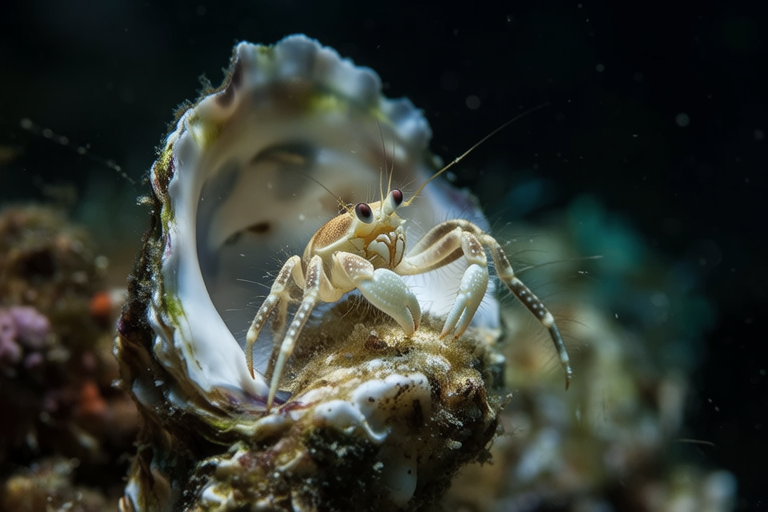
The Intricate Relationship Between Pea Crabs and Their Marine Hosts
Pea crabs, belonging to the superfamily Pinnotheroidea, lead a life hidden from view, nestled within the bodies of various marine mollusks. These diminutive crustaceans have evolved a remarkable symbiotic relationship with their hosts, one that is both complex and mutually beneficial. This article delves into the fascinating world of pea crabs, exploring their unique lifestyle, physical adaptations, and recent scientific discoveries.
The Symbiotic Relationship: A Dance of Interdependence
The relationship between pea crabs and their hosts is a delicate balance of mutualism, where both parties benefit from the association. Pea crabs typically reside within the mantle cavity of bivalve mollusks, such as oysters, scallops, mussels, and clams. The crabs gain protection from predators and access to a constant supply of food, while their hosts receive help with cleaning and parasite removal.
Pea crabs are highly specialized for their parasitic lifestyle. They possess elongated legs and claws that allow them to reach into the gills of their host to feed on plankton and other organic matter. In return, the crabs provide a cleaning service by removing parasites and debris from the host’s body, thereby enhancing its health and longevity. This mutualistic relationship is further reinforced by the fact that pea crabs are often found in pairs, with one crab residing on each side of the host’s body, ensuring comprehensive care.
Physical Adaptations for a Life Within
The physical adaptations of pea crabs are nothing short of extraordinary, enabling them to thrive in their confined, dark environment. Their flattened bodies and flexible exoskeletons allow them to maneuver through narrow spaces within the host’s shell. Pea crabs also have long antennae and sensory structures that help them navigate their surroundings and detect potential threats.
Another crucial adaptation is their ability to molt within the safety of their host. Unlike most crustaceans, which shed their exoskeleton in open water, pea crabs undergo this process inside the host’s mantle cavity. This ensures they remain protected during the vulnerable period when their new exoskeleton is still soft and pliable. Additionally, pea crabs have developed mechanisms to avoid triggering the host’s immune response, allowing them to coexist peacefully without causing harm.
Benefits and Challenges of the Parasitic Lifestyle
The parasitic lifestyle offers numerous advantages for pea crabs, including enhanced survival rates and a reliable source of food. However, it also presents several challenges. One of the primary risks is competition for resources within the host’s limited space. Pea crabs must compete with other organisms, such as bacteria and fungi, for nutrients and oxygen. To overcome this challenge, they have developed efficient feeding strategies, such as filtering water through their host’s gills to capture plankton and detritus.
Another significant challenge is the risk of being expelled by the host. While pea crabs have adapted to minimize this threat, there is always a possibility that the host may reject them if they become too burdensome. To mitigate this risk, pea crabs have evolved behaviors that reduce their impact on the host, such as limiting their activity levels and avoiding areas of high stress.
Recent Scientific Discoveries and Theories
Recent scientific research has shed light on several aspects of pea crab behavior and ecology. One intriguing discovery is the presence of chemical signals that facilitate communication between pea crabs and their hosts. These signals may play a role in regulating the relationship, ensuring that both parties benefit from the association. Another area of interest is the potential for pea crabs to influence the reproductive success of their hosts. Some studies suggest that the presence of pea crabs may enhance the fertility of certain bivalve species, although more research is needed to confirm this hypothesis.
Recent genetic analyses have also provided insights into the evolutionary history of pea crabs and their hosts. These studies indicate that the relationship between pea crabs and their hosts has existed for millions of years, suggesting that both parties have evolved together over time. This long-term association has led to the development of specialized traits and behaviors that enhance the success of both partners.
Conclusion: A Fascinating Secret Life
The life of pea crabs within their marine hosts is a testament to the wonders of nature and the power of symbiosis. These tiny crustaceans have adapted to an existence hidden from view, thriving in environments that would be inhospitable to most other creatures. Through their unique relationship with their hosts, pea crabs have found a way to survive and prosper, offering valuable lessons in cooperation and adaptation.
As we continue to explore the secrets of the ocean, it is likely that we will uncover even more about the fascinating world of pea crabs and their hosts. Future research may reveal additional insights into their behavior, ecology, and evolutionary history, deepening our understanding of this remarkable symbiotic relationship. For now, we can marvel at the intricate dance of interdependence that plays out within the shells of bivalve mollusks, a dance that has been unfolding for millions of years and shows no signs of stopping.
