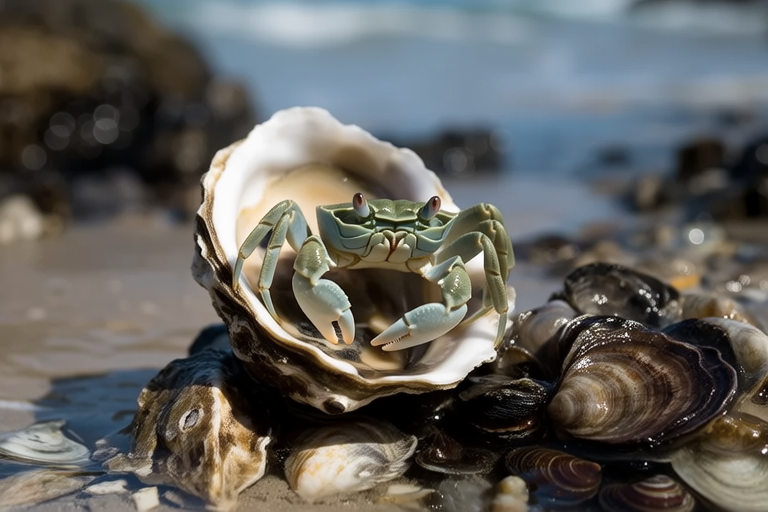
The Unique Symbiotic Relationship Between Pea Crabs and Their Bivalve Hosts
Imagine a world where tiny creatures live comfortably inside larger ones, benefiting from each other’s presence. This fascinating scenario is played out daily in our oceans, where pea crabs (family Pinnotheridae) reside within bivalves such as oysters and mussels. This unusual partnership, known as endosymbiosis, has evolved over millions of years, resulting in a complex yet harmonious relationship that showcases nature’s ingenuity.
Living Inside Bivalves
Pea crabs are small, translucent crustaceans that inhabit the gill chambers of various bivalves, including oysters, mussels, and scallops. These crabs are highly specialized, with flattened bodies that allow them to fit snugly between the host’s valves. They enter the host through the inhalant siphon, a tube used by bivalves to filter water for food. Once inside, they remain protected from predators and harsh environmental conditions.
Benefits and Adaptations
The symbiotic relationship between pea crabs and their hosts is mutually beneficial. For the crabs, living inside a bivalve provides shelter, protection, and a steady supply of food. The bivalves’ gills serve as a rich source of organic matter, which the crabs consume. In return, the crabs help their hosts by preying on parasites that might otherwise harm them. Additionally, the crabs’ presence can stimulate the host’s immune response, potentially enhancing its overall health.
Pea crabs have adapted physically to life within their hosts. Their flattened bodies reduce drag within the narrow spaces of the bivalve’s gill chamber, while their elongated appendages allow them to reach food sources efficiently. Furthermore, they possess specialized mouthparts designed for filtering and consuming the organic matter found in the host’s environment.
Mutualism and Evolutionary Insights
The mutualistic relationship between pea crabs and their hosts is an excellent example of co-evolution, where both partners have adapted to each other over time. Research suggests that this relationship may have originated around 50 million years ago when early ancestors of pea crabs began living inside bivalves. As the crabs adapted to this lifestyle, so did their hosts, leading to the development of specialized structures that facilitate the crabs’ entry and survival.
Scientists have discovered that the presence of pea crabs can influence the reproductive success of their hosts. Studies have shown that infected oysters produce more eggs than uninfected counterparts, possibly due to the increased availability of nutrients provided by the crabs. This finding highlights the complexity of this symbiotic relationship and underscores its importance in marine ecosystems.
Challenges Faced by Pea Crabs
Despite the many benefits of living inside bivalves, pea crabs face several challenges within their host environments. One significant issue is the limited space available within the gill chambers, which can lead to competition for resources among multiple crab individuals. Additionally, the crabs must navigate the host’s defense mechanisms, such as closing its valves tightly or expelling foreign objects.
Another challenge is the potential threat posed by parasitic infections. While pea crabs can help protect their hosts from certain parasites, they themselves are susceptible to infection. Research has shown that some species of pea crabs carry parasitic nematodes that can impair their reproductive capabilities. This finding emphasizes the delicate balance maintained within this symbiotic relationship.
Diverse Species and Host Relationships
There are approximately 80 species of pea crabs worldwide, each with unique adaptations suited to their specific host species. For example, Pinnixa fabulosa, commonly found in Pacific coast waters, lives within the gill chambers of the Olympia oyster (Ostrea lurida). Another species, Pinnixa littoralis, inhabits the blue mussel (Mytilus edulis) along the Atlantic coast. Meanwhile, Pinnixa granulata resides within the eastern oyster (Crassostrea virginica) in estuarine environments.
In tropical regions, different species of pea crabs have adapted to live within various bivalve hosts. For instance, Pinnixa longipes inhabits the giant clam (Tridacna gigas) in coral reef ecosystems. This adaptation allows the crabs to take advantage of the nutrient-rich waters surrounding these massive mollusks. Similarly, Pinnixa millepunctata has been observed living within the mangrove oyster (Crassostrea rhizophorae) in mangrove forests.
Ecological Significance
The symbiotic relationship between pea crabs and their hosts plays a crucial role in maintaining the health and stability of marine ecosystems. By preying on parasites and stimulating the host’s immune response, pea crabs contribute to the overall well-being of their hosts. Moreover, the presence of pea crabs can influence the distribution and abundance of bivalve populations, which in turn affects the broader marine community.
Pea crabs also serve as an important food source for various predators, including fish, birds, and larger crustaceans. This trophic connection highlights the interconnectedness of marine ecosystems and underscores the importance of preserving these delicate relationships.
Implications for Marine Biodiversity
The study of pea crabs and their hosts offers valuable insights into the complex web of interactions that shape marine biodiversity. Understanding these relationships can inform conservation efforts aimed at protecting vulnerable species and maintaining ecosystem health. Furthermore, research into pea crabs and their hosts may provide inspiration for biomimetic applications in fields such as medicine and engineering.
As climate change and human activities continue to impact marine environments, it is essential to consider the far-reaching consequences of disrupting these symbiotic relationships. By promoting sustainable practices and supporting conservation initiatives, we can help ensure the continued existence of these remarkable partnerships and the vibrant ecosystems they support.
