Quick & Easy Recipes
How To Cook Perfect Pasta In Less Than Ten Minutes
Speedy Perfection on Your Plate
## How To Cook Perfect Pasta In Less Than Ten Minutes
In the fast-paced rhythm of modern culinary life, few dishes offer as much comfort and versatility as pasta. However, a lingering misconception suggests that creating restaurant-quality results requires hours of simmering or an intricate process reserved for trained chefs. The truth, however, lies somewhere between tradition and innovation. It is entirely possible to cook perfect pasta in less than ten minutes without sacrificing flavor, texture, or nutritional value. This comprehensive guide dismantles the myths surrounding slow cooking and provides you with the precise knowledge needed to execute a flawless pasta dish efficiently. Whether you are rushing after work, hosting a casual gathering, or simply seeking the ultimate weeknight solution, mastering this technique transforms your approach to Italian cuisine forever.
### The Myth of Slow Pasta Cooking
For decades, home cooks have been taught that the key to delicious pasta lies in patience. We often see packages recommending twenty-minute boil times, leading many to believe that undercooking leads to failure. This belief system, while rooted in tradition regarding dried semolina pasta from the early 20th century, ignores the advancements in milling technology and the diverse nature of dried goods available today. Many commercially produced pastas utilize bronze cutting dies which increase surface roughness, allowing sauces to cling effectively, yet they can still achieve optimal gelatinization in a shorter timeframe than traditional recipes suggest.
The primary myth we must address is the equation of time equals tenderness. While extended boiling does soften the exterior of the noodle, it often comes at the cost of structural integrity. Overcooked pasta loses its resistance, turning mushy and releasing excessive starch into the water prematurely. By understanding that specific pasta shapes—particularly thin cuts like spaghetti, linguine, and angel hair, as well as certain extruded shapes like fusilli and penne—are designed for rapid hydration, we can reclaim control of our cooking window. Achieving al dente status, literally meaning "to the tooth," does not require a marathon; it requires precision. This shift in mindset allows you to finish meals faster while ensuring the carbohydrate structure remains intact, offering a satisfying chew rather than a bland slurry.
Furthermore, the flavor profile of pasta is not diminished by speed. Unlike rice or grains which absorb liquid slowly to develop flavor, pasta is primarily a vehicle for sauces. Its flavor contribution comes from the wheat and egg proteins interacting with the sauce fats. Therefore, the goal is not to cook the pasta until it tastes like bread, but to prepare the canvas for the sauce. When you cook quickly using high-quality ingredients, you preserve the natural nuttiness of the durum wheat semolina. The urgency often found in commercial kitchens, where efficiency drives excellence, proves that haste is not the enemy of quality; ignorance of technique is. By adopting professional strategies used in busy trattorias, you can bypass the unnecessary wait times and deliver a consistent product every single time.
### Preparation: Equipment and Water Strategy
The foundation of rapid pasta cooking begins before the pot ever hits the burner. Many amateur cooks fail to notice that the vessel size directly impacts boiling velocity and water temperature stability. Using a small pan forces a large volume of cold pasta to drop the water temperature significantly upon contact. If the water boils over slowly or stops boiling for long periods, the pasta absorbs water unevenly, leading to a gummy texture on the outside while remaining hard in the center.
To counteract this, you must invest in a large stockpot. Ideally, you want a capacity of at least five gallons for two pounds of pasta. This ratio ensures that the noodles have room to move freely, preventing clumping and facilitating even heat distribution. A larger volume of water also holds thermal energy better. When you drop pasta into this reservoir, the temperature drop is minimal, allowing the water to return to a rolling boil much faster. This consistency is vital because a steady boil keeps the surface of the pasta moving, reducing stickiness and preventing the exterior from breaking down into a starch paste.
Another critical component of preparation is the water itself. The quality of tap water can influence the outcome, especially in areas with hard water containing high mineral content. Hard water can sometimes inhibit gluten strands from forming properly, resulting in a softer noodle. Softened water generally yields a firmer bite. Regardless of source, you should never skip salting the water. Salt serves two functions: it seasons the pasta from the inside out, since the pasta absorbs water as it hydrates, and it slightly elevates the boiling point of the water. For the quickest results, add coarse sea salt once the water has reached a full rolling boil. Adding it earlier can sometimes cause pitting in stainless steel pots if the concentration gets too high near the bottom, but a pinch added with the rest of the water works perfectly fine.
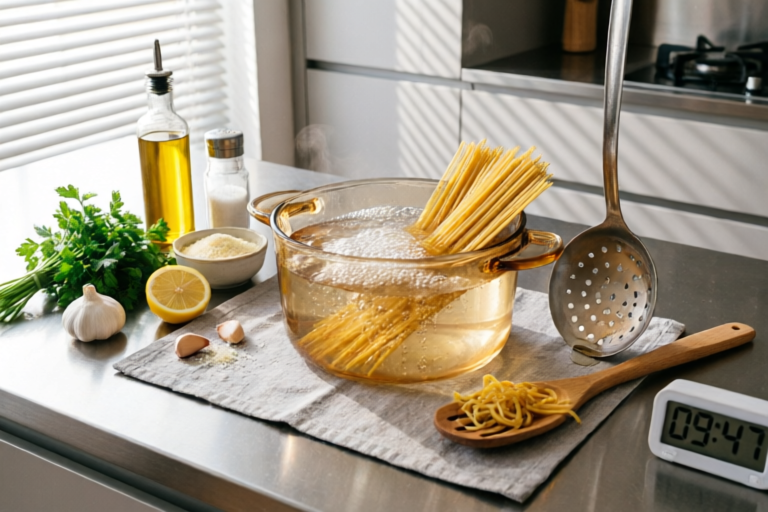
Timing the addition of pasta is equally strategic. Do not drop the noodles into tepid water. The water must be at a violent boil. If the water is merely simmering, the exterior of the pasta will dissolve into the broth before the interior has had a chance to cook. This phenomenon creates the dreaded "glue-like" texture that plagues rushed meals. Additionally, consider the lid strategy during the initial phase. Covering the pot initially traps heat and accelerates the time it takes to reach a boil. Once the water is bubbling vigorously and you have added your pasta, you should remove the lid. Removing the lid prevents the water from foaming over excessively due to starch release and allows you to monitor the texture easily. Keeping the lid on creates a feedback loop of bubbles that can lead to scorching or overflow, negating the efficiency gains you sought by starting with a covered pot.
Stirring is the most important mechanical action in the early stages. You must stir the pasta immediately after dropping it in the water. Within the first thirty seconds, the outer layer of the noodle begins to swell and become sticky. If left untouched, the strands will bond together into a solid mass. Using a long-handled wooden spoon or fork, ensure every strand is submerged and separated. After the initial minute, stir again every two minutes. This habit maintains the integrity of the individual noodles and ensures that the heat penetrates uniformly. Neglecting this step is the primary reason why home-cooked pasta sticks together, ruining the ability of the sauce to coat each piece evenly later on.
### Technique: Rapid Boiling and High Heat Management
Mastering heat transfer is the secret weapon for cooking pasta quickly. In a home kitchen, burners vary widely in BTU output. Gas ranges generally offer instantaneous heat modulation, while electric coils may lag. To achieve a sub-ten-minute cook, you must treat the burner setting as a variable, not a fixed position. Set the flame or heat element to maximum power immediately after adding the water. Do not lower it to "medium-high" or "keep warm." You need vigorous turbulence in the water to maintain a rolling boil despite the thermal shock of adding room-temperature pasta.
Once the pasta is in the pot, manage the heat dynamically. Some chefs argue for lowering the heat to prevent overflow, but for speed, you need aggressive agitation. If the pot threatens to bubble over, increase airflow (for gas) or fan the edges of the flame. Avoid turning the heat down so low that the bubbles stop. Small bubbles indicate the water is stagnant; large bubbles indicate convection currents. Large bubbles are necessary to scrub the surface of the pasta clean. This constant motion acts similarly to agitation in an industrial mixer, ensuring fresh water contacts the noodle surface for even heat absorption. This technique reduces the overall cooking time because the heat transfer coefficient increases with turbulence.
Partial cover placement plays a nuanced role here. As mentioned, you should uncover the pot once the boil is established and pasta is added to monitor progress. However, if your stove is underpowered or you live at a high altitude where water boils at a lower temperature, keeping the lid ajar can help retain some heat without causing an eruption. This is a compromise for high-altitude cooking where water simply does not boil as hot. In standard conditions, leaving the pot open allows moisture to escape rapidly. You must compensate by using a higher heat setting. This evaporation actually concentrates the starch in the water, which becomes beneficial later during the saucing phase. You want a concentrated starch bath to help bind your sauce to the pasta, and rapid boiling with evaporation achieves this concentration naturally.
It is also important to understand the interaction between pasta shape and heat. Thin strands cook faster because their surface-area-to-volume ratio is higher. Thick shapes like rigatoni or large shells take longer. If you are aiming for the ten-minute benchmark, choose shapes known for speed. Spaghetti, vermicelli, capellini, and thin farfalle will easily hit al dente within six to eight minutes. Larger shapes might push toward the ten-minute mark even with aggressive heat management. Knowing your shape allows you to calibrate your expectation. Do not expect a giant orecchiette to cook in the same time as angel hair. Adjust the variables accordingly. If you must cook a bulky shape, pre-cutting or scoring them (though not recommended for aesthetics) could help, but selecting the right shape is the superior strategy.
Finally, consider the type of pot material. Stainless steel retains heat well but may distribute it differently than copper or aluminum. A thick-bottomed pot ensures that there are no cold spots where pasta can sit and stick. Copper pans offer superior conductivity, meaning the entire surface heats up simultaneously. If you lack a copper top, ensure your base is flat and thick to prevent warping, which can create uneven heating gaps. Even heating is synonymous with even cooking time, and even cooking time saves you minutes of guessing whether the noodles are done. Always check the bottom of the pasta visually when lifting it out to ensure there are no hardened bits.
### Execution: Precise Timing and Texture Testing
Timing is the delicate balance between anticipation and realization. The printed instructions on the pasta box are rarely accurate. Manufacturers often err on the side of caution to avoid customer complaints about undercooked noodles. They assume a slower burner and larger volume of pasta per person. Relying on the box clock adds minutes you cannot afford. Instead, trust your senses. Start the clock one full minute before the package suggests. If the package says ten minutes, you begin checking at nine minutes. This proactive approach accounts for the cooling effect of the pasta dropping into the water.
Texture testing is the only foolproof method to determine doneness. Never rely solely on visual cues like floating pasta. Floating is a sign that air pockets have filled the noodle, but it does not guarantee the center is hydrated. The best test is the tactile taste test. Remove a strand of pasta with tongs, blow on it to cool slightly, and take a bite. It should snap with a slight resistance in the center. If it snaps instantly like chalk, it is undercooked. If it bends completely and offers no resistance, it is overcooked. The sweet spot is where you hear a distinct "bite" or resistance. This is the definition of al dente. Practice makes perfect. After three or four attempts, you will learn to recognize the specific resistance of your brand of pasta.
Another indicator is opacity. Raw pasta is opaque and white. As it cooks, the center becomes translucent. When the white dot in the center disappears, the pasta is almost finished. However, relying solely on this can be risky with thicker noodles. Combine transparency with the bite test for the highest accuracy. If you are making multiple batches or cooking different shapes, label your timer or use a phone app with distinct alarms. Cross-contaminating timings will lead to one batch being mushy while another remains raw.
Draining technique also affects timing perception. Once the pasta reaches the desired texture, it continues to cook from residual heat even after draining. This carries-over cooking is inevitable. Therefore, you should drain the pasta exactly when it is slightly under-done. If you wait until it is perfectly al dente in the pot, it will likely be overdone on the plate. Pull the pasta from the water forty-five seconds before you think it is ready. Immediately plunge the colander under cold running water ONLY IF you plan to eat it later or make a cold pasta salad. If eating hot, do not rinse the starch off. Save that starchy water!
Shifting to the next phase involves understanding the carry-over effect. The heat retained in the noodle will continue to soften the interior for the duration of the saucing process. If your sauce is hot and you add the pasta to it, let them come together for a minute. This final step allows the sauce to adhere. If the pasta is fully cooked before hitting the sauce, you risk having a dry noodle. If the pasta is slightly undercooked before hitting the sauce, the sauce steam finishes it gently. This dual-stage cooking method is a hallmark of professional Italian kitchens. It ensures the noodle is perfectly integrated with the sauce flavor.
Common execution errors include rinsing with hot water (which dulls the starch) or letting pasta sit in the colander. Sitting pasta causes condensation to form, making the noodles soggy. Drain quickly and transfer immediately. Also, do not leave the lid open on the stove while waiting for the water to boil if you are distracted. Modern burners with electric coils pose a burnout risk if forgotten. Keep an eye on the steam rising from the pot. Vigorous steam means the boil is active. Weak steam means the water is settling. Adjust accordingly.
### Conclusion: Saucing and Immediate Serving
The final stage of cooking pasta is arguably the most critical for flavor delivery. A perfectly boiled noodle thrown onto a cold sauce will fail. Conversely, a mediocre noodle tossed with a vibrant, hot sauce can shine. The goal is to achieve an emulsion. This chemical bonding occurs when the starch released by the pasta interacts with the fat in the sauce and the water. To facilitate this, reserve about one cup of the boiling pasta water before draining. This liquid gold is rich in starch and acts as a glue for your sauce.
When transferring the pasta to the saucepan, it should be sizzling. Pour in a splash of the reserved water and agitate the mixture vigorously. Shake the pan or toss with tongs continuously. This mechanical agitation breaks down the fats in the sauce into tiny droplets suspended in the water, coating the pasta uniformly. Without the pasta water, oils separate from acidic components like tomatoes or vinegar, resulting in greasy or watery sauces. With it, you create a creamy, velvety texture without needing heavy cream. This technique is essential for finishing the dish within those last few minutes of total cooking time.
Serving immediately is non-negotiable. Pasta continues to lose moisture and heat exposure degrades the sauce. If you let it sit in the serving bowl for twenty minutes, the noodles will absorb the sauce, becoming dry and bland. Serve directly from the pan to the plate. Use warm plates to maintain temperature longer. Warm glassware is preferable to cold ceramic which might shock the food. Garnish immediately with cheese or herbs. Cheese melts unevenly if it sits too long, and basil wilts rapidly in steam, losing its aromatic punch.
Safety considerations also apply here. Handling boiling water requires focus. Keep the handle of the pot turned inward to prevent knocking it over. Use oven mitts when lifting the heavy pot. Be cautious of the steam escaping the colander when pouring the pasta. The steam cloud contains boiling water vapor and can cause serious burns. Direct the steam away from yourself. Additionally, ensure your pasta is cooked enough to avoid digestive issues associated with raw wheat germ, though under 10 minutes is usually sufficient for dried goods.
In summary, cooking perfect pasta in under ten minutes is a skill built on understanding physics, biology, and chemistry. By utilizing large pots, aggressive heat, precise timing, and immediate saucing with reserved water, you elevate a staple ingredient into a culinary experience. Stop adhering to rigid timers and start trusting the tactile feedback of the noodle. Your dinner will taste better, you will waste less energy, and you will enjoy the satisfaction of mastering a classic technique. The kitchen is a place of experimentation, but the rules of heat and water remain constant. Embrace them, adapt them, and soon, ten minutes will feel like ten years in the luxury of flavor.
## Frequently Asked Questions About Quick Pasta Cooking
**Can you use instant pasta for faster results?**
Yes, instant pasta varieties exist and cook in under five minutes. However, they often lack the texture of dried semolina. They are convenient for camping or emergency situations but may not hold sauce as well as regular pasta. Stick to dried shapes for the best al dente experience.
**Is olive oil necessary in the cooking water?**
No. Adding oil to the boiling water is a myth that prevents the sauce from adhering to the pasta. Oil floats on top and does not mix with the water. Add olive oil directly to the sauce instead.
**What happens if I forget the pasta water?**
The dish will still be edible, but the sauce may look oily or separated. You can try whisking in a little butter or cream to mimic the emulsification effect, but fresh pasta water is the superior choice.
**Does water hardness matter?**
Yes. Very hard water can make pasta softer and more prone to breaking. Soft water preserves firmness. Adjust boiling times slightly if you notice a difference in your local supply.
### Final Thoughts on Meal Efficiency
Integrating these tips into your weekly routine streamlines meal prep significantly. You can reduce cleanup time by combining steps, such as pre-measuring salt and having the pot ready before chopping vegetables. Efficiency is not just about speed; it is about flow. When you know exactly how the water behaves, how the heat transfers, and how the timing aligns with the sauce, cooking becomes rhythmic rather than reactive. Trust the process, and you will find that the perfect bowl of pasta arrives on your table faster than you thought possible.
Comments

chef_momma
Made linguine tonight. Taste was spot on, felt like restaurant quality. Thanks for the breakdown!
👍 13👎 0

college_eater
Finally something faster than instant ramen lol. Saved it for later.
👍 7👎 0
stovetop_guru
Great tips! Just remember to salt the water heavily though, otherwise it tastes bland regardless of speed.
👍 23👎 0

dinner_hustle
Loved the section on checking texture early. I used to just set a timer and hope for the best.
👍 12👎 0

sauce_master
That tip about saving the starchy water changed everything for me. The sauce clings so much better now.
👍 8👎 0

new_to_cooking
Does this trick work with whole wheat pasta? Or will it get tough if you rush it?
👍 18👎 0

pasta_princess
Holy cow this actually worked! My pasta wasn't mushy at all. Definitely keeping this as my go-to for busy nights 🍝
👍 22👎 0